Interactive Capability Assessment Toolset (ICAT)
Transforming Data into Operational Intelligence
CFT’s Interactive Capability Assessment Toolset (ICAT) transforms complex mission engineering, operations research, and communications analysis outputs into decision-ready operational intelligence.
We close the data-to-decision gap by shifting from static data products to dynamic, mission-focused insight, enabling leaders to rapidly understand performance, risk, and trade-offs within a single, unified view.
Unlocking Operational Clarity
CFT’s Interactive Capability Assessment Toolset (ICAT) transforms complex mission engineering, operations research, and communications analysis outputs into dynamic Operational Intelligence (OI). Leveraging Microsoft Power BI as a structured analytical platform, CFT consolidates disparate data sources into validated, traceable data models that support mission-level insight and system-level drill-down capability.
ICAT serves as the decision-delivery layer of our analytical framework, integrating structured queries, operator-informed logic, and mission-aligned visualization techniques to convert modeling outputs into interactive, operationally relevant dashboards. Rather than producing static reports or fragmented data products, CFT enables leaders to rapidly understand performance, risk, and trade-offs through a unified, mission-focused interface.
By maintaining analytic integrity and full data traceability throughout the transformation process, ICAT ensures that mission metrics, communications performance assessments, and architecture trade studies remain defensible, repeatable, and aligned to operational priorities. This is Business Intelligence elevated to Operational Intelligence, designed to accelerate decision cycles and enhance joint mission effectiveness.
Objective
-
Unlock operational clarity by transforming complex mission and engineering data into decision-relevant insight
-
Close the gap between data collection and operational value extraction
-
Deliver measurable mission impact visibility at speed
CFT leverages Microsoft's Power BI as an operational intelligence platform, not simply a reporting tool

Operationalize – Embed operator-informed logic tied to mission threads and performance metrics
Integrate – Normalize and validate disparate mission data into a unified analytical model
Proven
Process
Deliver – Provide interactive dashboards that enable rapid, defensible decision-making

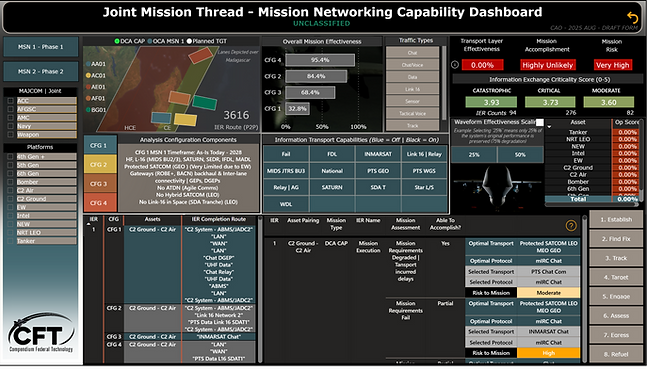
The dashboard views shown here represent the analytical layer of ICAT, where mission metrics, IER performance, and communications impacts are quantified and compared. Below, the same data is abstracted into a mission-focused visual representation, illustrating how communications effectiveness directly affects engagement timelines and operational success.
Structured Data Modeling
↓
Validated Analytics
↓
Dynamic Visualization
↓
Operational Understanding
ICAT does not replace analysis, it operationalizes it
Mission Performance in a Single View
Operational dashboards translate modeling, simulation, and analysis outputs into intuitive, decision-focused visualizations. Complex mission-thread data, communications performance assessments, and trade-off analyses are transformed into structured operational intelligence environments that clearly communicate mission impact.
By integrating validated analytical logic with dynamic visualization techniques, ICAT enables leaders to quickly identify performance gaps, assess architecture effectiveness, and understand the operational “so what” behind the data. The result is accelerated comprehension without sacrificing analytic rigor
Dynamic Operational Dashboards
Mission Performance in a Single View
-
Display mission accomplishment probabilities
-
Highlight performance impacts
-
Surface operational gaps and risk areas
-
Compare baseline and alternative architectures
-
Support rapid trade-space evaluation

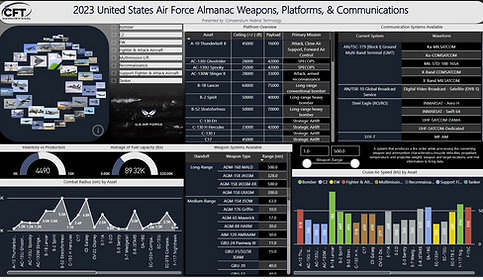
Informational Dashboards
Informational dashboards function as dynamic almanacs, providing structured visibility into platforms, systems, networks, and capabilities. These dashboards answer:
-
Who has what capability?
-
How is it employed?
-
What are the relevant system characteristics?
They consolidate reference data, system specifications, and operational context into interactive formats, eliminating reliance on static documents or sifting through fragmented data repositories.
Why ICAT Matters
Modern defense programs generate massive volumes of engineering data, communications modeling outputs, and operational analysis results.
ICAT ensures that this data does not remain buried in static reports.
It transforms structured analysis into operational understanding, enabling leadership to move from data awareness to mission advantage.
-
Immediate visibility of mission status, risk, and performance trade-offs
-
Actionable insight derived from complex multi-domain datasets
-
Reduced analyst and decision-maker burden
-
Elimination of manual data correlation across fragmented products
-
Trusted, repeatable analysis grounded in traceable data logic
-
Enhanced decision superiority through clarity and speed
Redefining how ME outputs are consumed