


CFT’s Operations Research capability combines advanced quantitative analysis with decades of real-world operational expertise. Our team includes Joint Interface Control Officers (JICOs), communications integration specialists, and experienced operations analysts who understand how complex systems perform in contested environments, not just in theory.
We apply disciplined decision science to optimize resource allocation, evaluate cost-performance-risk trade-offs, and inform high-stakes acquisition and modernization decisions across complex defense portfolios.
Operations Research & Decision Optimization
Where Experience Meets Analytics
While many firms can build models, effective Operations Research requires credible assumptions and operational realism. CFT integrates subject matter experts with analytical professionals to ensure that:
-
Constraints reflect real-world operational limitations
-
Communications and network dependencies are accurately represented
-
System interdependencies are properly captured
-
Assumptions align with doctrine, tactics, and mission execution realities
This fusion of operational insight and quantitative rigor ensures our recommendations are executable, not abstract.
Our Approach
Define the Decision Problem
We clarify objectives, constraints, stakeholders, and measurable success criteria.
Structure the Trade Space
We identify decision variables, resource limitations, performance drivers, and risk factors that influence outcomes.
Quantify Performance & Risk
Using Monte Carlo simulation, optimization techniques, sensitivity analysis, and statistical modeling, we evaluate baseline and alternative cases.
Isolate Key Drivers
We determine which variables materially impact mission effectiveness, cost, survivability, or resiliency
Deliver Decision-Ready Insight
We translate quantitative findings into clear trade-off assessments that inform acquisition strategies, budgeting decisions, and modernization priorities
Analytical Methods & Operational Environments
CFT supports Analysis and Experimentation Campaigns that provide a holistic understanding of how planned communications architectures enable — or fail to enable — end-to-end Joint Mission Thread (JMT) effects.
Our team integrates Joint Communications and Data Network subject matter experts with operations analysts to evaluate:
-
End-to-end System-of-Systems (SoS) performance
-
Communications interoperability and data flow integrity
-
Operational gaps and mission impacts
-
Network resiliency under contested conditions
-
Cross-platform integration across current and next-generation systems

Operator Influenced Data
Through structured experimentation, simulation, and trade space evaluation, we assess how communications architectures support mission command, targeting cycles, and joint operational effects.
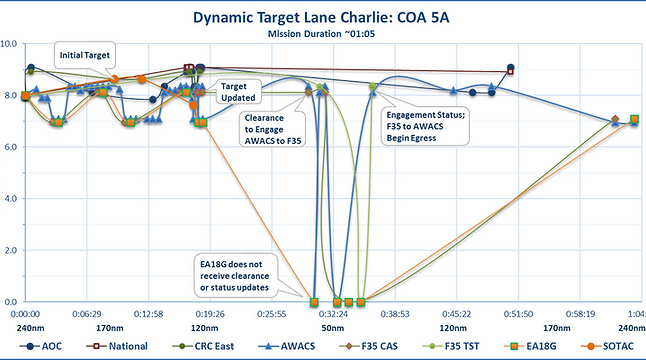
Our analysis environments
-
End-to-end operational simulation
-
Communications and transport layer modeling
-
Network performance experimentation
-
Sensitivity and degradation scenario analysis
-
Portfolio-level trade and optimization modeling
This ensures analytical outputs remain directly tied to real operational objectives
CFT’s Operations Research analysis directly informs warfighter requirements, modernization priorities, and strategic investment decisions.
Our work:
-
Identifies operational gaps across Joint Mission Threads
-
Quantifies communications effectiveness across contested environments
-
Evaluates interoperability between current and next-generation platforms
-
Supports FYDP and POM decision cycles with defensible performance data
-
Enables integration and exploitation of emerging technologies
-
Determines optimal communications architectures aligned to mission objectives
Proven Operational Impact
By grounding quantitative analysis in operator-informed assumptions, we ensure recommendations are not only mathematically sound, but operationally executable.
Our approach strengthens interoperability, reduces risk against near-peer threats, and enables weapons systems and networks to achieve full mission capability in complex joint environments.

Operator-Informed Information Quality Framework
-
Mission-Relevant Data Accuracy
-
Timeliness to Support Decision Cycles
-
Completeness Across End-to-End Kill Chains
-
Interoperability Across Joint and Coalition Networks
-
Traceability from Data Source to Operational Effect