


Mission Engineering
Modeling mission effectiveness to inform capability decisions
CFT’s Mission Engineering (ME) approach integrates systems, operational context, and analytical rigor to evaluate how capabilities perform across complex, contested environments. We move beyond technical specifications to quantify operational impact, enabling leaders to assess risk, tradeoffs, and investment priorities with confidence.
CFT Mission Engineering
CFT delivers structured Mission Engineering analysis that integrates operational context, system architectures, and analytical rigor to evaluate mission effectiveness across complex environments. Our team links information exchanges, system performance, and operational scenarios to measurable mission outcomes, enabling data-driven capability assessments and modernization decisions.
Our Mission Engineering approach supports acquisition planning, capability integration, and investment prioritization by quantifying operational impact, not just technical performance. Through disciplined modeling, architecture development, and trade analysis, CFT provides defensible insight into risk, resiliency, and mission success across current and future force designs.
What Is Mission Engineering?
Mission Engineering (ME) is an interdisciplinary process that applies systems engineering to entire missions, not just individual systems. It integrates operational needs, system capabilities, and mission context to evaluate how Systems of Systems perform together to achieve desired mission outcomes.
Rather than asking “Does the system work?” Mission Engineering asks, “Does the integrated architecture achieve the mission?”

Why the DoW Emphasizes Mission Engineering
The Department of War recognizes that engineering effective systems is not enough. Systems must function cohesively as part of a broader System of Systems (SoS) in contested operational environments.
Mission Engineering links:
-
Systems
-
Mission Threads
-
Architectures
-
Measurable Mission Outcomes

Mission Engineering Methodology from the DoD MEG 2.0
Core Mission Engineering Concepts
Mission
The task and purpose that define the operational objective
Mission Thread (MT)
The end-to-end sequence of mission activities required to execute a mission
Mission Engineering Thread (MET)
The execution of mission activities by specific actors, systems, and organizations within a given operational context (often referred to as kill chains or effects chains)
Mission Engineering & Mission Effectivness
1. Define the Mission Problem
-
Clearly establish the operational problem, scope, scenario, and mission objectives driving the analysis.
2. Characterize the Mission Context
-
Define the scenario, threat laydown, operational environment, force structure, CONOPS, and mission success criteria using authoritative sources.
3. Develop the Mission Architecture
-
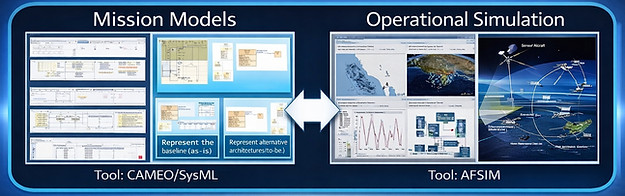
Digitally model baseline mission threads and engineering threads (MTs/METs) to represent how systems execute the mission within the selected scenario.
4. Conduct Operational Analysis
-
Implement baseline and alternative architectures in operational simulations to evaluate mission outcomes using quantitative metrics.
5. Compare Alternatives
-
Insert new technologies, concepts, or capabilities into the architecture and assess mission impact through structured analysis, sensitivity testing, and Monte Carlo runs.
6. Deliver Results & Recommendations
-
Provide data-driven recommendations to inform acquisition, experimentation, requirements, and technology investment decisions.
Mission Engineering Methodology from the DoD MEG 2.0
_edited_edited_edited_edited.jpg)
Our Mission Engineering Methodology
Analytical & Modeling Toolsets
Implementing ME Methodology
Our ME methodology ensures that capabilities are evaluated in the context of real operational execution, not in isolation. Using established mission frameworks such as F2T2EA (Find, Fix, Track, Target, Engage, Assess), we map mission activities to specific systems, organizations, and information exchanges to create validated ME Threads (METs). These digital architectures reflect how operators actually fight and are grounded in authoritative doctrine, plans, and subject matter expertise. We then execute these architectures in operational simulations to quantify mission effectiveness and provide data-driven recommendations that directly inform warfighter outcomes and investment decisions.
Fit-for-Purose Modeling
Operational Simulation & Mission Modeling
-
AFSIM
-
ASCOT
-
STK (Systems Tool Kit)
-
NRL Scenario Builder
-
Command PE
Model-Based Systems Engineering (MBSE)
-
Cameo / SysML
-
Enterprise Architecture modeling frameworks
-
Microsoft Visio (process & architecture visualization)
Communications & Network Analysis
-
GL Communications LinkSim / MAPS
-
Software Defined Radio (SDR) environments
-
RF and transport layer simulation tools
From Architecture to Measurable Outcomes
Delivering Decision-Ready Insight
Our analyses do more than validate systems, they reveal how integrated architectures perform in contested environments. By comparing baseline and alternative mission threads, we provide quantitative evidence of where capabilities enhance mission success, and where they do not.
The result is clear, defensible insight that supports:
-
Requirements development
-
Capability portfolio decisions
-
Technology maturation pathways
-
Risk reduction strategies
-
Mission-focused modernization
CFT ensures that engineering effort translates directly into operational advantage.
Quantified probability shifts across operational conditions provide defensible decision support for modernization and acquisition

